Category: Vegetables


Cheddar cheese and onion tart

February 20th, 2011 — 7:32pm

I pride myself on being able to make dinner out of what looks like nothing. I get into this zone where I think I’m in some kind of Ready Steady Cook-style competition and get all excited about how I can make a 3 course dinner out of an old bag of nuts and an egg. I didn’t make a 3 course dinner, I just made a tart, but still.

It’s good for using up any odds and ends of cheese, this tart. Chuck ‘em all in there. I used the fading remains of a block of cheddar plus 3 types of onion: red, white and spring. The pastry was shop-bought, knocking around in the freezer. It was rich, filling and mmmm cheesy. Not bad for a bit of fridge foraging.

Cheddar cheese and onion tart

150g cheddar cheese, crumbled
2 large red onions, sliced into thin half moons
2 medium white onions, sliced into thin half moons
4 spring onions, finely chopped (white and green parts)
1 clove garlic, crushed
1 sprig rosemary (or thyme), leaves removed and finely chopped
2 eggs
100ml double cream
250g shortcrust pastry
Salt and white (or black) pepper

This recipe fills a 24cm tart dish.

Begin by caramelising the onions. Heat 2 tablespoons of vegetable or groundnut oil in a heavy based frying pan and add the red and white onions. Once they are sizzling, turn the heat down as low as possible and let them cook gently for about an hour, stirring every so often, until very soft and caramelised.

Preheat the oven to 190C/fan 170C/gas 5. Roll out the pastry to fit the dish and carefully lay it in, covering the base and sides. You want the pastry to overhang the sides by a couple of centimetres, as it will shrink during cooking. Make sure to patch up any holes. Fill the pastry base with baking beans (or dried beans or rice) and cook for ten minutes before removing from the oven and setting aside.

Mix the cheese with the spring onions, rosemary, eggs, cream and caramelised onions when ready. Season with salt and white pepper. Pour the filling onto the tart base and spread evenly. Bake for 25-30 minutes until golden brown.

Serve warm or cold with a sharp green salad.

22 comments » | Cheese, Foraging, Lunchbox, Main Dishes, Pastry, Picnic, Tarts, Vegetables

Fantastic fritters: 2 recipes

February 1st, 2011 — 9:04am

I really do love a good fritter. Salt fish fritters for when I’m feeling very ‘Peckham’ or juicy corn fritters at the end of summer when there’s so much corn going cheap I can’t fry fast enough. Recently, I’ve been grating all those stubborn winter root vegetables into submission.

First to get the treatment were the beets; grated into the mix with whole chickpeas and sharp feta cheese, sizzled and drizzled with minty yoghurt.

The carrots got shredded in with plenty of fresh coriander leaves and spring onions, fried till orange-gold and served with a ginger infused sauce. You can’t really go wrong with fritters; as long as the mixture isn’t too sloppy and your oil is hot you’re set for crisp and crunchy dinner satisfaction. A few singed edges here and there on your first batch won’t matter either.

Frittering root veg seems to bring out their sweetness, which is why the slightly sour yoghurt works so well as an accompaniment. I prefer the creamy full-fat Greek style version but if you want to use regular or even (shudder) low-fat then cut back on the citrus juice, it will be too astringent otherwise. Seriously though, you’ve just fried vegetables in oil, enjoy them properly.

Carrot and coriander fritters with gingery yoghurt (serves 4 as a starter)

500g carrots, grated
4 spring onions, finely chopped
2 cloves garlic, crushed
1 heaped teaspoon cumin seeds, toasted
Handful coriander leaves, chopped
3 tablespoons flour
2 eggs, beaten
Salt and pepper
Oil, for frying

For the yoghurt

250g thick natural yoghurt
Squeeze of lime juice
1 inch piece ginger

Once the carrots are grated, squeeze them to extract as much juice as possible. Mix with the rest of the fritter ingredients. Squeeze some of the mixture together in your hands to make sure it won’t fall apart when cooking. If you think it will, add either some more beaten egg or flour, but just a little.

Cook the fritters in batches: heat a 1cm depth of oil in a heavy-based frying pan. When hot, drop spoonfuls of the batter into it, immediately pressing flat with a spatula. It’s important not to crowd the pan; you’ll probably cook 3 at a time. Cook for 3-4 minutes each side or until golden. Don’t be tempted to turn the fritters before they have formed a good crust underneath, or they will break. Remove to a plate covered with kitchen paper to drain with excess oil then keep warm in a very low oven while you cook the remaining fritters.

Mix the yoghurt and lime juice in a bowl. Cut the ginger into small pieces and squeeze through a garlic crusher – all the juice should come out in the bowl and any ginger root should be finely crushed. Serve dolloped on top of the hot fritters.

Beetroot, chickpea and feta fritters with minty yoghurt (serves 4 as a starter)

350g cooked beetroot (if cooking yourself, simmer whole then rub the skins away afterwards)
200g cooked chickpeas
100g feta cheese, crumbled
2 tablespoons parsley leaves, finely chopped
4 spring onions, finely chopped
Zest of ½ lemon
½ teaspoon ground cumin
1 egg, beaten
3 tablespoons flour (plain white flour or chickpea flour)
Salt and pepper
Groundnut or vegetable oil, for frying

For the sauce

250g tub thick natural yoghurt
Handful mint leaves
Juice of 1/2 lemon

Salt and pepper
To make the sauce, put the yoghurt, mint and lemon juice in a blender and whizz until thoroughly mixed. Taste and season with salt and pepper

To make the fritters, grate the beetroot into a large bowl then transfer to a sieve and press down to squeeze out as much of the juice as you can. Transfer back to the bowl and mix in all the other fritter ingredients. Season with salt and pepper but be sparing with the salt as the feta is salty. Squeeze some of the mixture together in your hands to make sure it won’t fall apart when cooking. If you think it will, add either some more beaten egg or flour, but just a little.

Heat a 1cm depth of oil in a heavy based frying pan. Drop spoons of the batter into the hot oil, immediately spreading out to a flat fritter shape (the fritters need to be the same thickness all over).

It’s important not to crowd the pan; you’ll probably cook 3 at a time. Cook for 3-4 minutes each side then set aside to drain on kitchen paper. Don’t be tempted to turn the fritters before they have formed a good crust underneath, or they will break. The fritters can be kept warm in a very low oven while you cook the next batch.

Serve at once with the sauce.

11 comments » | Fritters, Vegetables

Egg yolk ravioli

January 24th, 2011 — 8:35am

Yeah, quite chuffed with these. I thought it sounded near impossible to slip an egg yolk into the centre of a ravioli and cook it without it either busting out into the water or completely over-cooking and to be honest the latter worried me more; the idea of hard-boiled yolk encased in pasta is just really, really grim.

Anyway they are actually quite easy. You have to make your own pasta of course, so it depends how you feel about that and you really will need a machine because the pasta needs to be as thin as you can possibly get it. That would be a long hard slog with a rolling pin and I ain’t no Nonna. It’s easy when you make pasta at home to be fooled into thinking you have it thin enough when you don’t, which is exactly what happened to me the first time I made these. They cooked perfectly, but the pasta was just too fat and gluey.

The next time I pushed right through to the heady heights of setting number 9 on the machine and was rewarded with papery pasta sheets. I made a spinach and ricotta mixture which doubled up as a stand to keep the yolk in place (an idea I tea-leafed from Nicky who used a ricotta and herb mix and took some incredibly good pictures). It’s important to have a large pan so you don’t overcrowd it with ravioli and to have the water at an enthusiastic simmer rather than a boil (to avoid eggy bursts). A mere 2-3 minutes will cook the pasta through (remember it’s very thin, and fresh) and the yolk will remain gooey and ooze out onto the plate creating a rich sauce.

I bathed them simply with melted butter, crushed pink peppercorns, lemon zest and some of the purple basil that my mum grew and I have somehow managed to keep alive. I love how they look all pretty and delicate but are actually packing the punches with pasta, egg and butter. They’re deceptively light in the eating too, dangerously so in fact. You’ll only want one or two per person but there’s no need to worry about not being full; it would be a crime not to mop up all those golden buttery juices with a slice or two of good bread.

Egg yolk ravioli (serves 4)

200g 00 flour (strong white flour)
2 eggs
A pinch of salt

For the filling

8 small eggs
200g spinach leaves
100g ricotta
1 tablespoon grated Parmesan
Black pepper

Sift the flour into a large bowl. Make a well in the centre and crack the eggs into it. Add the salt. Bring the pasta mix together until you have a rough dough. Knead it on a lightly floured surface until smooth and silky. Wrap in clingfilm and leave to rest for half an hour.

Meanwhile, wash the spinach and without drying it put it straight into a small saucepan on a low heat and put a lid on. Steam until wilted down. Drain, then when it is cool enough to handle, squeeze as much water from it as possible and chop finely. Add to a bowl with the ricotta and Parmesan. Add some black pepper. Taste and add some salt if you like.

Roll out the pasta to the thinnest setting using a pasta machine. Cut into 16 large squares on a well floured surface (you want to leave enough room to cut around the ravioli easily without the stuffing coming out of the sides). In the middle of every other square, put a blob of ricotta mixture, then make a dimple in the centre large enough to hold an egg yolk. Make sure the sides are high enough so that the yolk won’t spill over. Crack an egg over a bowl into your hands so that you are left holding the yolk and the white drains into the bowl through your fingers. Carefully slip each yolk into the middle of the ricotta mixture.

Bring a large pan of salted water to the boil and then reduce it to a simmer. Brush some of the leftover egg whites around the edges of each ravioli and place another pasta square on top. Seal the ravioli carefully easing out any air bubbles towards the edges. Use a glass or teacup to cut each ravioli into a circular shape.

Use a fish slice to pick up each ravioli and place gently into the water. Cook for 2 minutes until the pasta is just cooked and the yolk still runny. Serve with melted butter mixed with crushed pink peppercorns and chopped lemon zest. Garnish with basil.

33 comments » | Cheese, Eggs, Main Dishes, Pasta, Vegetables

Ottolenghi’s stuffed onions

January 5th, 2011 — 5:47pm

The second Ottolenghi book (Plenty), is just as beautiful as the first. All the recipes are veggie, which fits perfectly with my wishy washy intentions to eat hardly any meat in January. Apart from when I eat out, which is quite a lot. I ate chicken just last night for example and very delicious it was too.

Anyway, these stuffed onions are pretty amazing. Poached onion layers are filled with feta, herbs, spring onions and breadcrumbs. The latter provide substance and are gooey and swollen with flavour from the cooking stock. We ate some of them on their own with a salad then immediately ate the rest from the baking dish with our hands. The most unexpectedly rich and comforting dish I’ve eaten in a very long time.

Ottolenghi’s Stuffed Onions (in theory, they could serve 4 but there’s no chance to be honest. Serves 2). I’ve also made his black pepper tofu from the same book.

500ml veg stock
350ml white wine
4 large onions
3 small tomatoes
120g white breadcrumbs
90g feta, crumbled
80g parsley leaves, finely chopped
3 tablespoons olive oil
3 spring onions, finely chopped
3/4 teaspoon salt
Black pepper

Butter, for greasing the dish

Preheat the oven to 180C and grease a baking dish with butter.

Combine the wine and stock in a saucepan and bring to the boil. While this is happening, trim the top and bottom from the onions, cut them lengthways in half and remove the skin. Carefully remove most of the insides to leave 3 or 4 outer layers of onion. Carefully separate these. Turn the stock to a simmer and put the onion layers in it, a few at a time. Cook them for 3-4 minutes or until just tender then set aside. Keep the stock.

To make the stuffing, grate the tomatoes into a bowl using a coarse cheese grater. Most of the skin will be left behind in your hands and you can discard it. Add the feta, breadcrumbs, parsley, olive oil, spring onions, salt and some pepper. Mix well.

Fill each onion layer generously and roll into a ‘fat cigar shape’. Place fold side down in the dish. Pour over about 75ml of the stock. Bake for 45-50 minutes or until they are brown and charred in places and bubbling underneath. You can add more stock if they look like they’re drying up during cooking. Serve warm.

28 comments » | Cheese, Vegetables

Baked gnocchi with Gorgonzola and spinach

January 3rd, 2011 — 2:11pm

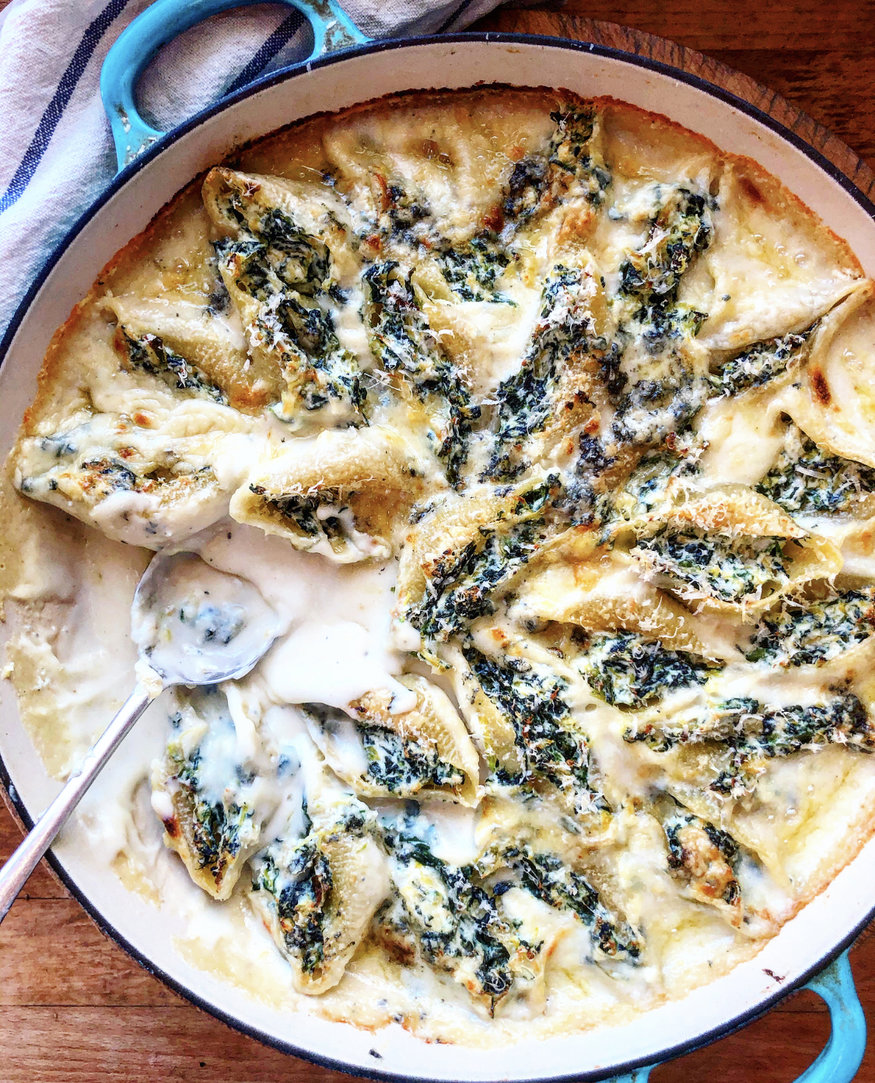
Now I know you’re all thinking about diets, detox and exercise. So am I. Let me lead you astray for a moment though as I reminisce about this baked gnocchi I made for my boyfriend’s birthday. We’d started with a venison carpaccio to keep space inside for this baked behemoth – home made gnocchi crisped on top and creamy down under, oozing wads of Gorgonzola.

I’d not made gnocchi at home before and I was startled at the difference; they were very light compared to shop-bought. I was careful not to add too much flour to the mixture because that makes them tough, apparently. Then again, too much potato and they may fall apart during cooking. Many recipes stated so many different ratios of potato to flour that in the end I threw up my arms, huffed and stomped. Then I remembered that bible of Italian cooking, The Silver Spoon. Their recipe suggested 1kg  potato to 200g  flour which of course worked an absolute treat.

Baking gnocchi is a bit like frying or baking pasta, adding another texture on top. I used a creamy rather than piccante Gorgonzola as I wanted it nice and gooey; the cheese basically forms the sauce along with a splash of double cream for good measure. The spinach worked well although you could use chard, cavolo nero or other greens instead. A sharp, lemon dressed salad on the side will balance the richness. In your face, detox!

Baked gnocchi with Gorgonzola and spinach

For the gnocchi

1kg potatoes
200g plain flour, plus extra for dusting
1 egg, lightly beaten
Salt

Steam the potatoes for about 25 minutes, or until tender. Mash with a potato ricer or beat with an electric whisk (as I did) until perfectly smooth. Stir in the flour, egg and a pinch of salt and knead to a soft, elastic dough. Shape the dough into long sausages about 1.5cm in diameter. Cut into 2cm lengths. Press each gnocchi with a fork or the underside of a grater and set aside on a tea towel dusted with flour in a single layer.

Bring a large pan of lightly salted water to the boil and cook the gnocchi, a few at a time, until they rise to the top. Remove them and drain.

For the sauce

Gorgonzola (as much as you dare, I wasn’t really in a measuring mood. Probably used about 250g).
Double cream (again, wasn’t measuring. Look, there’s no way this can go wrong so don’t worry too much about quantities. Probably about 100ml).
Spinach, 200g (ha! I knew that one)
A little Parmesan for the top
White pepper, black pepper and salt

Preheat your oven to 180C

Wash your spinach and then, without drying it, put it into a saucepan on a low heat. Put a lid on. Let it wilt then drain it well and squeeze to rid it of some moisture (if you use more cabbage-like greens such as chard or cavolo nero you’ll need to cook them in boiling water). Put your cooked gnocchi into a baking dish, break up your cheese and spread it about; do the same with the spinach then pour over your cream. Season with white pepper, salt and black pepper. I think the two types of pepper makes a difference but you could leave one out. Grate over a little Parmesan and bake for 30 minutes or until golden brown and bubbling.

17 comments » | Gnocchi, Main Dishes, Vegetables

Moroccan-style carrot salad

December 3rd, 2010 — 1:49pm

When I used to order a veg box, I had to cancel carrots because I just couldn’t face ploughing through them every single week. This does mean though, that I’ve prepared carrots in just about every way possible and now that I can enjoy them again, I find I keep returning to this recipe.

It has a wonderful sweet and sharp balance, plus the smoky hum of toasted cumin seeds, plenty of zippy coriander and a good slug of olive oil. Dress the carrots while they are nice and hot so they suck up the dressing.

Warm Moroccan-style carrot salad

500g carrots, peeled and chopped into bite size chunks
1 teaspoon cumin seeds, toasted in a dry pan until fragrant
A small handful coriander leaves, roughly chopped
1 teaspoon hot chilli flakes
1 tablespoon red wine vinegar
1 teaspoon icing sugar (or to taste)
3 tablespoons olive oil, or more if you like
3 whole cloves of garlic, peeled

Cook the carrots with the whole garlic cloves until just tender. Meanwhile, combine the sugar, red wine vinegar, coriander, cumin seeds, chilli flakes and olive oil in a bowl. When the carrots are ready, mix them with the dressing. The garlic cloves will have mellowed and are also good to eat.

The salad keeps well and is nice cold too but make sure to give it a good mix before you serve as the dressing collects at the bottom of the bowl.

7 comments » | Dressings, Healthy, Salads, Side Dishes, Vegan, Vegetables

Okra pachadi

November 3rd, 2010 — 8:39am

Most of the recipes on this blog are my own, but sometimes I want to share others I’ve stumbled across, or those that people have sent to me. This pachadi recipe comes from Sharmila, a local food blogger who does Very Good Things with yoghurt and okra.

In my limited experience, a pachadi appears to be a base of yoghurt and vegetables, topped with a mixture of tempered spices; like pouring a tarka over a dahl. It’s clearly South Indian, as mustard seeds and curry leaves feature heavily in many recipes. My first chapadi experience came via Flickr when one of my contacts posted a recipe so unusual to my eyes that I had to have it. Mustard seeds, dried chilli and curry leaves are fried briefly in coconut oil until the seeds pop then mixed with yoghurt and cucumber. It’s hard to resist bombing a hot chapatti into the still-sizzling spiced oil. The flavours will have you on the edge of your seat.

Sharmila’s version is made using okra slices, fried until crisp; a beautiful contrast against the chilled yoghurt. It takes minutes to make and I can particularly recommend it as part of a  ‘curry day’ extravaganza; nargisi kofta curry, chicken tikka and this excellent spinach and paneer dish from Das Sreedharan’s hugely under-rated book, ‘Indian’*. Yes, I know I go on about that book all the time.

Okra pachadi

1 teaspoon black mustard seeds
10 or so curry leaves
2-3 green chillies, chopped into a few pieces
Chilli powder
Lemon juice
Coriander leaves
Two large handfuls of okra, chopped up into smallish (2cm pieces)
Natural yoghurt
Salt to taste
Groundnut oil

Fry the okra in a few tablespoons of groundnut oil until nice and crisp. Drain on kitchen paper.

Combine the okra with the yoghurt (about 200g) and a bit of chilli powder (but not too much – this isn’t a spicy dish). Fry the mustard seeds in a small pan in a tablespoon or so of oil. When they start to pop, add the green chilli and curry leaves. When they are nicely sizzling, pour over the yoghurt mixture. Stir to combine, add salt and lemon juice to taste and then add the coriander leaves.

* The edition of Das’ book that I have doesn’t seem to be available any more but this looks very similar and I imagine will have a lot of the same recipes. It’s one of those books you actually cook from rather than just flick through.

Thanks again to Sharmila for the chapadi recipe.

9 comments » | Curry, Dips, Sauces, Condiments and Spreads, Side Dishes, Vegetables

Back to top