In his excellent book, ‘The Yoghurt Cookbook‘, Arto der Haroutunian talks about the health promoting properties of the white stuff, and its supposedly life lengthening power. By my reckoning I should live until at least 180, providing the yoghurt can counteract a history of fags, booze and fast livin’.

Cultures that consume a lot of yoghurt, such as the Georgians, are huge believers in its supposed powers, and have used it as a cure for…well, pretty much everything actually, for centuries. I can’t vouch for the validity of those claims, but I can vouch for the taste, and its hangover-curing properties. This buffalo yoghurt made in a traditional clay pot brought me back from the brink; I’m talking nausea, shakes, the creeping doom…not a whisker of it after I’d gobbled this lot down at the side of a rocky road in Georgia.

The yoghurt I tried in Ethiopia recently was a little more…challenging. I asked the lady we were visiting how she made it, and she replied ‘well I just put the milk in this bucket (straight from the cow in the back yard) and leave it on the shelf for three days.’ That’s one approach, although it is of course really just curdled milk and not ‘proper’ yoghurt. The taste was very sour and it had a loose wobbly texture. The Ethiopians often mix it with chilli powder and drink the whole glass like a shot, and I can see why. I spent the next three hours concerned about potential gastrointestinal payback.
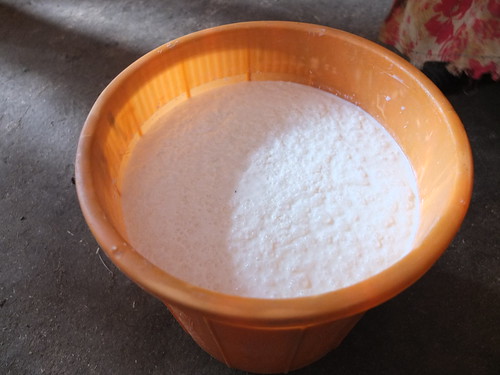
Yoghurt in Ethiopia

Mixed with chilli powder

Labneh, then, is basically yoghurt that’s been strained of its whey. Of course, I adore it because, well it’s like yoghurt to the power of ten. Once strained, the resulting substance is more akin to cream cheese, but with the obvious tartness of yoghurt; that sour freshness that yoghurt-lovers crave.

I’ve found that the best brand by far for making yoghurt is Total. It’s even better than the mega-expensive stuff I bought from the farmers’ market, which relinquished hardly any liquid. It is thick and creamy before straining  which is a good thing if you’re eating it straight up, but with labneh you want some residual sourness.
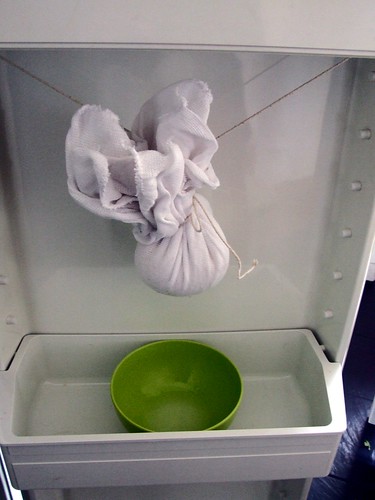
To make labneh, mix the yoghurt with a large pinch of salt, then wrap in muslin, or as I have done, a clean/brand new dishcloth. Hang in the fridge (to be honest I used to just hang it in a cool place but now I have a very hot kitchen so the fridge it is) and allow the whey to strain away for about 5 to 6 hours. The longer the strain, the thicker the labneh, obviously.

After this time it is ready, and can be used or preserved in a number of ways.

Try rolling in herbs and preserving in olive oil…it’s then lovely just spread on bread. It’s also delicious rolled in dukkah, or za’atar. Straight up it’s best topped with punchy flavours like anchovy and chilli, or dolloped onto salads as you would use a goat’s curd for example.

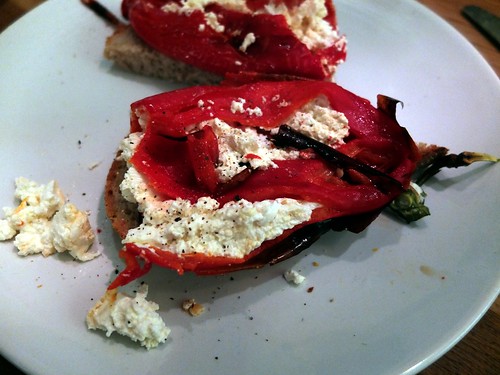
My favourite way to use it right now however is to stuff it into Turkish peppers before slinging them on the BBQ. They are lovely when wrapped up inside a flat bread with a kebab, oozing their creamy centres against the sizzling meat. If you’re up for it, you fly bastards, stuff some green chillies instead.

Labneh Stuffed Peppers Recipe

1 x 500g tub Total yoghurt
Large pinch of salt
About 5 mild green Turkish pepper for stuffing (you could also use the long red Romero peppers if you can’t find the Turkish ones)
Oil
Muslin or a dishcloth for straining

In a bowl mix the yoghurt with the salt. Line a bowl with the muslin or cloth and scrape the yoghurt into it. Tie the top with string or whatever you have and suspend it from something. I used to use a cupboard handle but now I have a very sun filled, hot kitchen and so I hung it in the fridge. Set a bowl underneath to catch the whey. Leave for 5 or so hours. It will be usable but soft after 3. If you want to make balls with it and preserve them in oil then the longer the better as the labneh will need to be fairly firm for rolling.

Cut the tops off the peppers and de-seed them without cutting the sides. Stuff with labneh. Rub with oil, salt and pepper and either grill on a BBQ or underneath a hot grill until charred in places and soft. Serve either in kebabs, or on toast, in pittas…
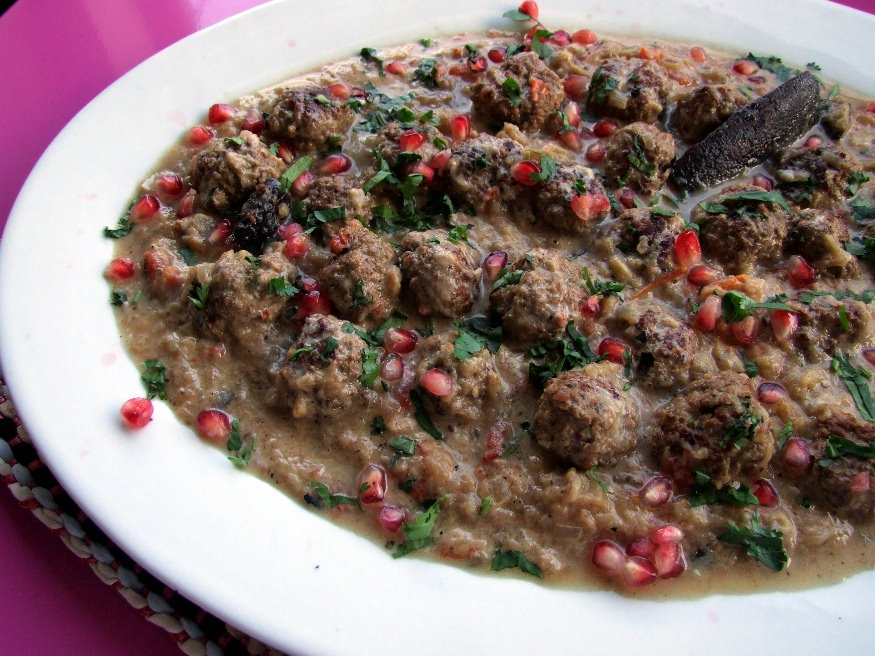
 

Lamb and Date Meatballs in a Frazzled Aubergine Sauce.

When shiny aubergines are placed over a naked flame, their skins blacken and they collapse inward on themselves with a steamy sigh. Once cooled and split, the inside is gloriously smoky; a total transformation. It is this creamy flesh that blends into dips such as baba ghanoush, but I like to use it as a base for a sauce.

The meatballs are made with lamb, dates and warming spices like cumin and chilli. I’ve nicked a trick from the Italians too and mixed in some breadcrumbs soaked in milk – just a little – so they become light and extremely easy to eat. A swirl of yoghurt and a few pomegranate seeds make this dish pretty. Serve with couscous or bread to absorb the luxurious sauce.

Lamb and Date Meatballs in Frazzled Aubergine Sauce

500g minced lamb
4 dates, pitted and finely chopped
1 heaped teaspoon cumin seeds
1 teaspoon coriander seeds
1 heaped teaspoon hot chilli flakes, or to taste
1 teaspoon dried mint
1 thick slice white bread
Milk (about 4 tablespoons)

For the sauce

4 aubergines
1 large onion, finely chopped
2 cloves garlic, crushed
1/2 400g regular tin chopped tomatoes
2 black cardamom
1 tablespoon pomegranate molasses
1 cinnamon stick
300ml vegetable stock

Vegetable oil, for frying

Pierce the aubergines in several places with a fork, then place directly on the gas ring of the hob, turning occasionally, until black and shrivelled all over. Alternatively, grill them to the same effect.

Remove the crusts from the slice of bread and break into rough pieces. Place in a small bowl with enough milk to mash to a paste.

In a small frying pan, toast the cumin and coriander seeds over a low heat, stirring frequently, until they start to smell fragrant. Take care not to burn them. Grind them in a spice grinder or crush them in a pestle and mortar.

In a large bowl combine the minced lamb, bread paste, ground cumin and coriander, chilli flakes, chopped dates and mint. Season with salt and pepper. Mix well; really , really well. Get in there with your hands and knead the mixture almost like a bread dough. Make sure the dates are well distributed. Roll into walnut sized balls. Set aside on a plate.

Heat 2 tablespoons of vegetable oil in the Le Creuset, and fry the meatballs in batches, 4 or 5 at a time, until golden brown all over. Set each batch aside while you cook the next.

To make the sauce, scrape the flesh from inside the aubergines, leaving behind the blackened skin. Chop roughly. Fry the onion until , cardamom pods and cinnamon stick until the onions are soft and beginning to colour. Scrape up the lovely meaty residues from the pan as you do this. Add the aubergines and garlic. Turn up the heat a little and Cook for about five minutes more stirring.

Add the tomatoes, pomegranate molasses and stock. Put lid on and cook for 45 mins to an hour on low heat. Taste and season. For a thicker sauce, remove the lid towards the end of cooking time to reduce it. Add back the meatballs to heat through.

Scatter with pomegranate seeds and coriander to serve.

It’s National Sandwich week, so obviously I’m all over that like ketchup on a chip butty. Or brown sauce if you’re, you know, NORMAL.

Anyway it seemed only right to honour the week with some sandwich bits and bobs so today I give you a recipe for what is a frankly outrageous piece of work – The Fool’s Gold Loaf. Made famous by Elvis ‘The King’ Presley, and taking its name from the reportedly stupendous price tag of $49.95. The story goes that Elvis would travel miles to eat this sandwich at the restaurant where it was invented, a joint called ‘The Colorado Mine Company’, in Denver. It’s said in fact that Elvis once flew his guests in from Memphis on his private jet just so they could eat it.

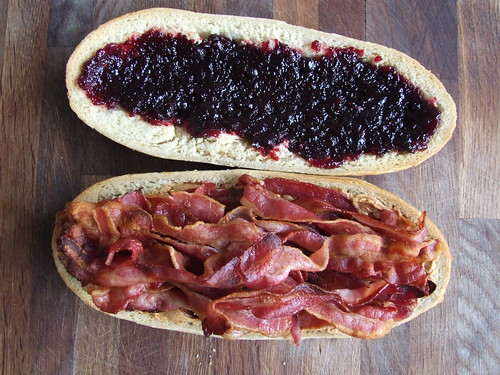
In true Elvis style this sandwich is a vision of excess – an entire loaf, hollowed out and filled with a jar (yes a jar) of peanut butter, followed by a jar (yes a jar) of grape jam, followed by a substantial amount (you get the idea) of crisp grilled bacon.

The combinations may sound odd, but the mixture of salty and sweet flavours isn’t that far out there; think bacon and maple syrup on waffles, or salted caramel ice cream. That said, I’ve never known a sandwich to elicit such a wide range of noises from people when eaten – a mixture of ‘mmm this is tasty’ plus ‘wow, this is wrong’ but ‘mmm this is tasty’; once you’ve had one bite, it’s  difficult to resist taking another.

This sandwich serves one, if you’ve the appetite of Elvis. It will serve approximately 8 ‘normal’ people however. Uh-huh.

Fool’s Gold Loaf

1 x approximately 11 x 4” white loaf
450g streaky bacon
250g smooth peanut butter
250g grape, blackcurrant, blueberry or plum jam
Butter, for spreading on the loaf

Preheat the oven to 150C.

Cut the loaf in half lengthways, leaving a little more thickness to the bottom half. Remove most of the crumb from the inside of each half, leaving a thickness of a couple of centimetres (or as much as you like). Spread each half with butter, inside and out.

Place the two halves on a baking tray and bake until toasted and lightly golden all
over (approx. 15 minutes).

While the bread is toasting, grill the bacon until crisp.

Spread the bottom half of the loaf with the peanut butter, then layer on the bacon. Spread the top half with the jam and sandwich together. Cut into slices to serve.

Cold Roast Lamb with Anchovy Sauce

Leftovers are, for me, almost always better than the original dish. Even as a child I always wanted everything cold; steak and kidney pie being my favourite. I remember the highlight of holidays away with a friend’s family being these pre-packed, jellied treats, an anti-dote to the PURE EVIL that we were given to drink (that’s hot Ribena for those who don’t know). Again, I preferred that cold.

This is a rip off of a Simon Hopkinson recipe for cold veal with anchovy sauce and sliced boiled eggs. The salty anchovies work just as well with cold lamb as they do when jimmied into crevices with garlic and rosemary and roasted in a hot oven. Instead of melting away however, here they retain their flavour which, for me at least, is a very good thing.

Cold Roast Lamb with Anchovy Sauce

For the sauce (makes enough sauce for 4 people) 

6 tablespoons mayonnaise
8 anchovy fillets
1 tablespoon wholegrain mustard
1 teaspoon white wine vinegar
Splash of water

Plus the rest…

Sliced cold roast lamb
Lettuce leaves
Finely shredded spring onions
Capers, rinsed

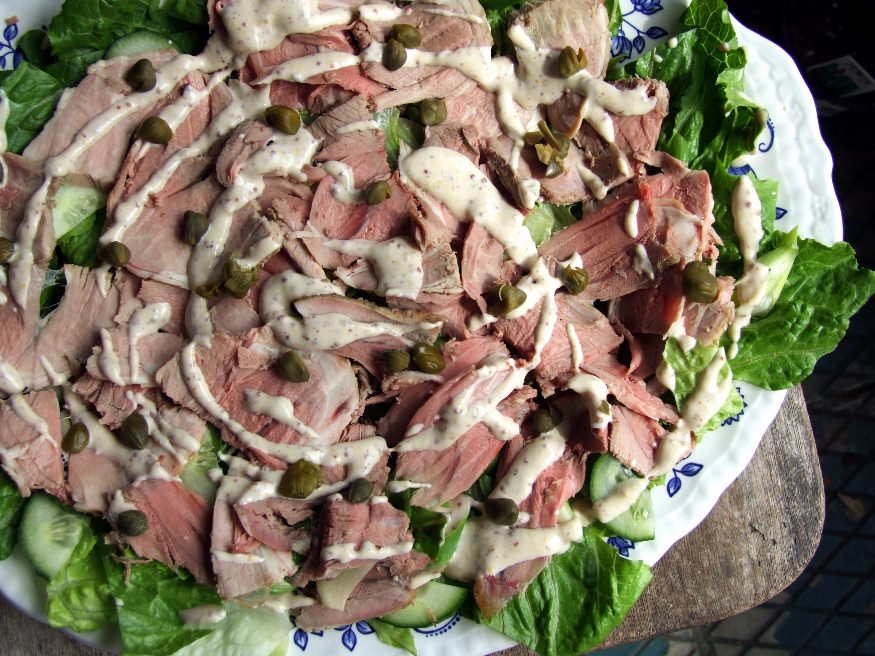
Lay the lettuce leaves on a plate and sprinkle with some finely shredded spring onions. Lay the sliced lamb on top.

Put all the sauce ingredients in a small blender and whizz them up. Taste and adjust the quantities, you may want a little more white wine vinegar for example. Drizzle the sauce over the lamb and dot with capers.

Never have I felt more like a fully fledged member of the Food Tosserati as when I found myself using raw milk from the farmers’ market to make this ice cream, then shortly after seasoning my dauphinoise with penja pepper, before jostling it into the fridge next to the batch of wild garlic pesto I’d made the day before. Oh dear.

Tell you what though, raw milk does taste fantastic. ‘Raw’ meaning unpasteurised. It’s rich and creamy and supposedly has health benefits which are destroyed by pasteurisation. I don’t know the evidence for this and frankly I don’t have time to look so if anyone out there has properly delved into it, I’d be grateful to know the outcome.

What I can tell you is that it makes fabulous ice cream. It was supposed to be prune and Armagnac, but there’s only so far a corner shop in Camberwell can stretch in the booze department, so prune and cognac it was and blimey, was it ever tasty.

I made this for dinner, for the boyfriend’s parents no less. When I took the first mouthful I thought ‘holy shit, this is a bit good’ but obviously kept my trap shut for fear of appearing smug or boastful. So if you want to impress parents or other such important people, and also erm, keep them regular, then make this ice cream.

Prune and Cognac Ice Cream

(fills 2 plastic tubs of the kind that takeaway food arrives in)

20 prunes, pitted and chopped (just chop each into about 3 pieces)
180ml cognac
60ml water
500ml double cream
500ml whole milk
225g caster sugar
6 large egg yolks

Simmer the prunes, cognac and water in a small pan, until 3/4 of the liquid has evaporated. Set aside to cool.

Scald the milk and cream (this means heating it until almost but not boiling, basically when bubbles start to appear around the edge, you’re done). Whisk the egg yolks and sugar together until they turn pale and start to thicken. Continue whisking, and add about 1/3 of the hot milk and cream mixture to the egg mix, then when it is incorporated, add the remaining mixture (again whisking all the time).

Pour the lot into a clean, heavy based pan and cook over a low-medium heat, stirring constantly, until the custard thickens and coats the back of a spoon. You can also test if it’s ready by drawing a line down  the custard on the back of the spoon with your finger. If the line stays, it’s ready. A thermometer makes this even easier. You’ll get the result you want at 80C.

Put the mixture aside in a bowl and add the prunes and any juices. Cover by placing a layer of cling film or greaseproof paper directly on top of the custard, to stop a skin forming. Leave to cool completely, before churning in an ice cream maker, then freezing for an hour or two before serving.

You can also make this without an ice cream maker, but you’ll need to remove it from the freezer every hour or so and either beat it with an electric mixer or hand whisk, the idea being to break up as many ice crystals as you can in order to make it as smooth and creamy as possible.